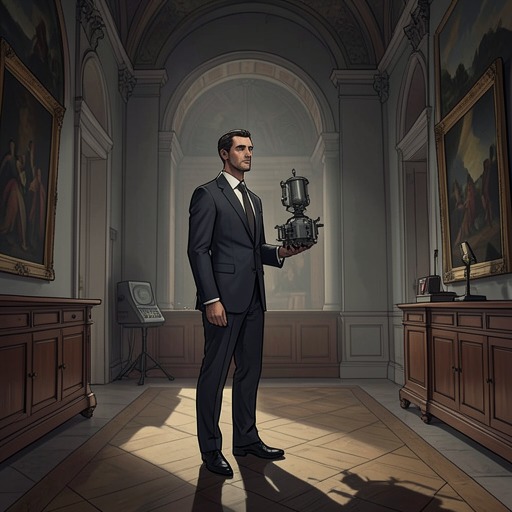
Osborne tries to frame Venables
The Pale HorseOsborne tries to frame Venables by turning a packet of thallium into apparent evidence against a man who has no knowledge of it, while presenting a false witness account to support the accusation. The attempt briefly casts suspicion toward Venables, but Lejeune’s account reverses the scene: Osborne planted the poison and was himself the man who followed and killed Father Gorman.
Background and purpose
The frame depends on the same substance that explains the murders. Lejeune identifies thallium salts as the poison used and notes that thallium was readily obtainable, including for use as rat poison. He also explains the broader deception: a pseudo-scientific psychological scheme, reinforced by superstition, was meant to distract from the straightforward administration of poison. In that context, a packet of thallium in Venables’s potting shed could make the crime appear to point toward him, while obscuring the method and the person who had actually used it.
The packet is not merely a suspicious object discovered by chance. Lejeune says the police found it tucked in a corner of the shed and had examined some of its contents for testing. When Venables hears that it is there, he reacts with surprise and insists that he knows nothing about it. His denial is consistent with Lejeune’s later explanation: Osborne had placed the salts there himself, without understanding Venables’s disability, and had cast him as the villain. The evidence planted to implicate Venables therefore becomes evidence of Osborne’s effort to manufacture a case against him.
The false accusation
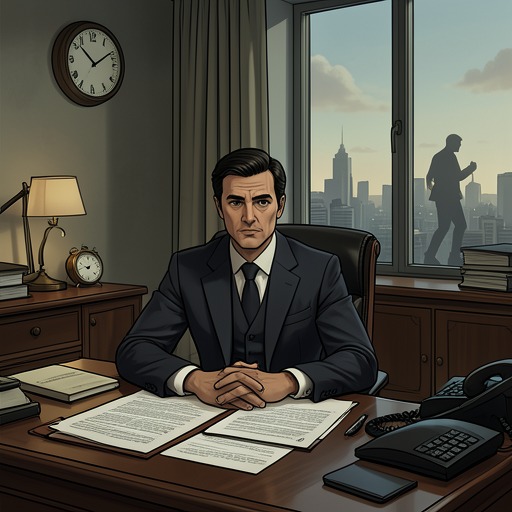
Osborne’s second move is to claim that he saw Venables following Father Gorman in Barton Street on the evening of October 7. The accusation gives the planted poison a supposed eyewitness context: Venables is presented not only as connected to the substance but as the person who had pursued the priest shortly before his murder. Osborne insists that he had described Venables exactly, making the allegation sound confident and specific.
Lejeune dismantles that account by distinguishing what Osborne claimed to have seen from where Osborne actually was. Osborne had not been standing outside his shop as he later represented. He was across the street, following Father Gorman himself. Lejeune says that Osborne came up with the priest after he turned into West Street and killed him. The apparent identification of Venables thus reverses into an identification of the accuser: Osborne’s claim is a projection of his own movements onto the man he is trying to incriminate.
Exposure of the planted evidence
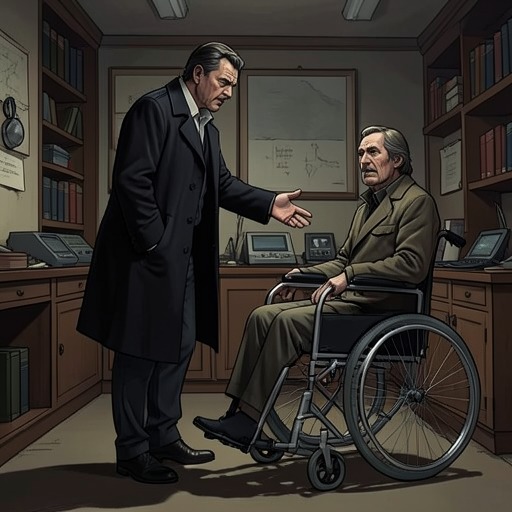
Lejeune makes the connection explicit by introducing Osborne to Venables as the pharmacist who had planted the packet of thallium salts in the shed. The accusation collapses on two linked points: the substance was deliberately put there, and the purported witness had fabricated the account that connected Venables to Father Gorman’s movements. The physical evidence and the testimony that seemed to reinforce each other are revealed as parts of the same frame-up.
Venables’s disability gives the planting a further, specific irony. Lejeune says Osborne did not know about it when he chose Venables as his supposed villain. Osborne had built his accusation around an imagined culprit without accounting for the person he was accusing. Lejeune also describes Osborne as obstinate and unwilling to admit his mistake. When the accusation is exposed, Osborne becomes agitated and protests that Lejeune has no idea what he has done or what he can do. His outburst does not restore the credibility of his story; it follows the disclosure that his own actions, rather than Venables’s, connect him to both the poison and the murder.
Consequences and significance
The attempted frame-up turns the investigation from suspicion of a wealthy householder into a direct confrontation with the man who arranged the deception. Venables first appears to face incriminating evidence in his own shed, but Lejeune’s explanation changes the meaning of that evidence: the packet is not proof of Venables’s guilt but proof that Osborne tried to divert attention. Likewise, Osborne’s confident claim to have recognized the follower becomes a confession in substance once Lejeune establishes that Osborne himself followed Father Gorman.
The episode exposes the practical limits of Osborne’s deception. The pseudo-scientific and superstitious cover story could disguise poisoning by making the deaths seem mysterious, and the planted thallium could point suspicion elsewhere; yet the same ordinary substance, once found and tested, anchors the explanation in material evidence. Osborne’s effort to make Venables the villain consequently sharpens the contrast between staged appearances and what the investigation can establish. The frame fails because Lejeune connects the planted packet to its planter and the false accusation to the accuser’s actual movements.